
-
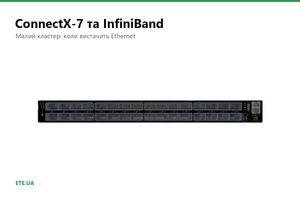 A two or four node cluster is limited by the fabric, not by the cards inside the boxes. We go through the ConnectX-7 datasheet figures, the difference between an MQM9700 with an on-board subnet manager and an MQM9790 without one, what RoCE really takes on Spectrum switches, why a single OSFP cage carries two NDR ports, and the workloads where 100GbE closes the question entirely.
 -
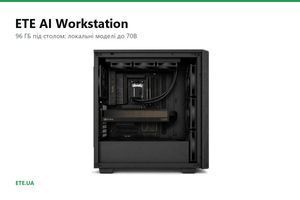 Not every team needs a rack and a server room. A workstation built on RTX PRO 6000 Blackwell 96 GB and Threadripper PRO 7975WX holds models up to 70 billion parameters, runs off a normal wall socket and sits in the office. We explain why 96 GB on a single card removes a whole layer of engineering, what ECC memory buys you, and why this is the natural step up from a DGX Spark.
 -
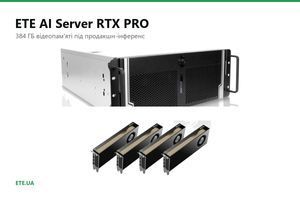 When several models run on one machine around the clock, what matters is not peak throughput but the price per gigabyte of GPU memory. Four RTX PRO 6000 Blackwell Server Edition cards give 384 GB, and MIG hardware partitioning turns them into a dozen logical cards so teams stop queueing. We compare it with the H200 build and explain why a rack takes the server edition of the card.
 -
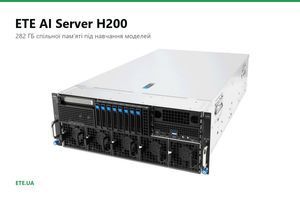 Two H200 NVL cards of 141 GB each, joined by an NVLink bridge, give 282 GB of shared memory. We explain why 64 cores, why a terabyte of system RAM and four power supplies, how much memory a 70-billion-parameter model eats and what changes during fine-tuning. The configuration follows the standard set by Exxact, BIZON and Thinkmate.
 -
 A customer used to buy the hardware in one place and look for the people who would deploy it somewhere else. Now one team covers both parts: ETE handles servers, GPUs and networking, Vixen.UNO handles virtualisation, clouds and Kubernetes. The partner has 72 virtualised infrastructures and 42 cloud migrations behind it. Who does what, and what you can order together.
 -
 The partner page is run by the manufacturer itself, and the ETE listing is there: six areas of competence, from data center GPUs to Omniverse. The directory holds 714 companies, and only 68 of them cover the full set of these six, that is 9.5%. We go through what stands behind each area, why the listing carries no retail lines and what partner status gives the buyer in practice.
 -
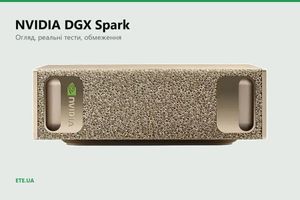 128 GB of unified memory in a box the size of a chunky router. We collected measurements from independent reviewers alongside NVIDIA's own figures to show where Spark is strong and where the slide-deck numbers part ways with reality. The core constraint is 273 GB/s of memory bandwidth, which is why a dense 70-billion-parameter model delivers 2.7 tokens per second for a single user.
 -
 Eleven of the fifteen Nutanix NX models take cards, and the per-node ceiling is four H100 or L40S in the NX-9151-G9. We went through which nodes support GPUs, how many VMs a card yields via MIG and vGPU, and why the L40S cannot be cut into hardware slices at all. Plus what the presentations leave out: MIG disables NVLink, and live migration demands identical hardware on both hosts.
 -
 MIG partitions a card in hardware, vGPU slices time and bills a license per user. We work out how many virtual machines fit on an RTX PRO 6000, an RTX PRO 5000 and an L40S, which profiles and licenses that takes, which hypervisors run MIG-backed vGPU, and why a card listing MIG on its datasheet may still refuse to enable it.
 -
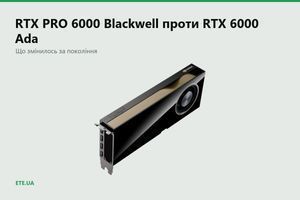 One card gives 48 GB on 300 W, the other 96 GB on 600 W. Between them sit twice the memory, a 512-bit bus instead of 384, fifth-generation Tensor Cores with FP4 support and MIG hardware partitioning that Ada never had. We pulled the datasheet figures together with real benchmark runs, so it is clear when the newer generation earns its surcharge and when Ada still covers the job.
 -
 An AD102 die, 48 GB of GDDR6 with ECC and 864 GB/s in a passive 350 W card. We go through what separates the L40S from the L40 (spoiler: TDP and the tensor figures in the datasheet, nothing else), how many virtual desktops it really carries, and why it hits 100°C in a workstation. Plus an honest list of the jobs where it loses to the H100 and the RTX 6000 Ada.
 -
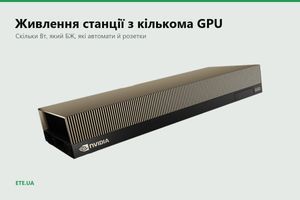 The 600 W on a card's data sheet is a requirement on the power supply, not the draw of the machine. We collected measured figures for one, two and four card builds, went through the sense pins of 12VHPWR and 12V-2x6, and explained why an RTX PRO 6000 in a server often caps at 450 W instead of 600. Plus the arithmetic for a 16 amp circuit.
 -
 The three RTX PRO 6000 versions share one GB202 die, 96 GB of GDDR7 and 24,064 CUDA cores, yet the official NVIDIA table shows neither bandwidth, nor MIG, nor vGPU. We pulled the numbers from the datasheets and the whitepaper: 1792 vs 1597 GB/s, 600 vs 300 W, how many cards fit into a chassis, and why the server card quietly caps itself at 450 W because of a cable.
 -
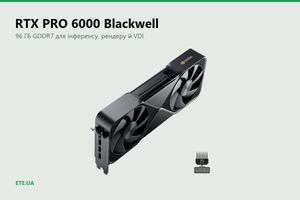 One GB202 die, 24,064 CUDA cores and 96 GB of GDDR7 with ECC across three editions: Workstation, Max-Q and Server Edition. Where the 1792 versus 1597 GB/s gap actually shows, what it really takes to enable MIG, and why a server card quietly settles at 450 W. Plus measured results in Llama 3.3 70B, Blender and V-Ray, and a power profile from idle to training.
 -
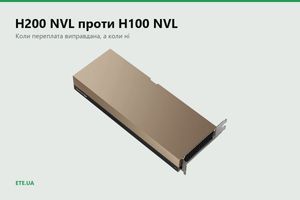 The compute silicon in both cards matches to the last digit: the same 835 TFLOPS in TF32 and 3341 in FP8. Every difference lives in memory, 141 GB against 94 and 4813 GB/s against 3938. We went through the workloads where the gain reaches 3.4× and the ones where it is zero, plus the arithmetic that tells you when the H200 NVL premium pays back.
 -
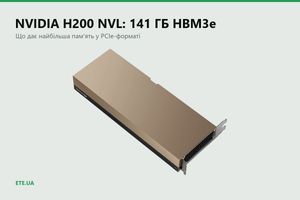 141 GB of HBM3e and 4,813 GB/s against 94 GB and 3,938 GB/s on H100 NVL, while the compute side of both cards is identical. We go through which models fit whole, how NVL differs from SXM, and what the four-card NVLink bridge actually delivers. Plus the case against buying it: the gain over H100 runs anywhere from zero to 3.4×.
 -
 Model weights are one multiplication, and the KV cache eats as much again or more: a 70B with a 128K context is 180 GB for a single user. We walk through the official NVIDIA formulas and show how many parallel sessions a 32, 48, 72, 96 or 141 GB card will hold. Plus two traps that keep a model from starting on a card the arithmetic says it fits.
We care about your privacy
This website uses cookies for marketing and statistical purposes and for a secure and optimal site experience. You can change this in your browser settings. Click on the «Accept cookies» button to consent using cookies. You can read more on the User agreement page.