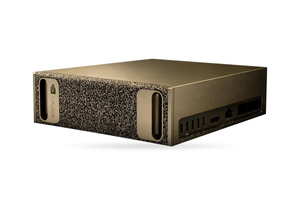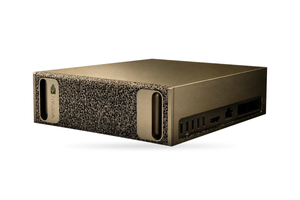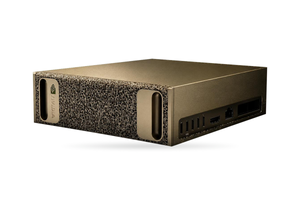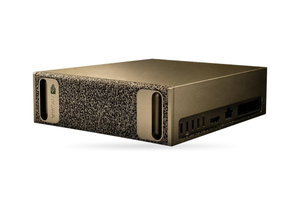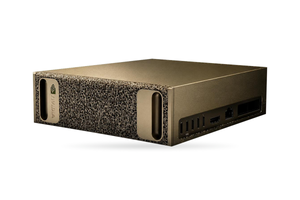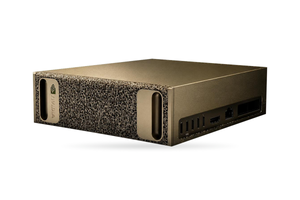
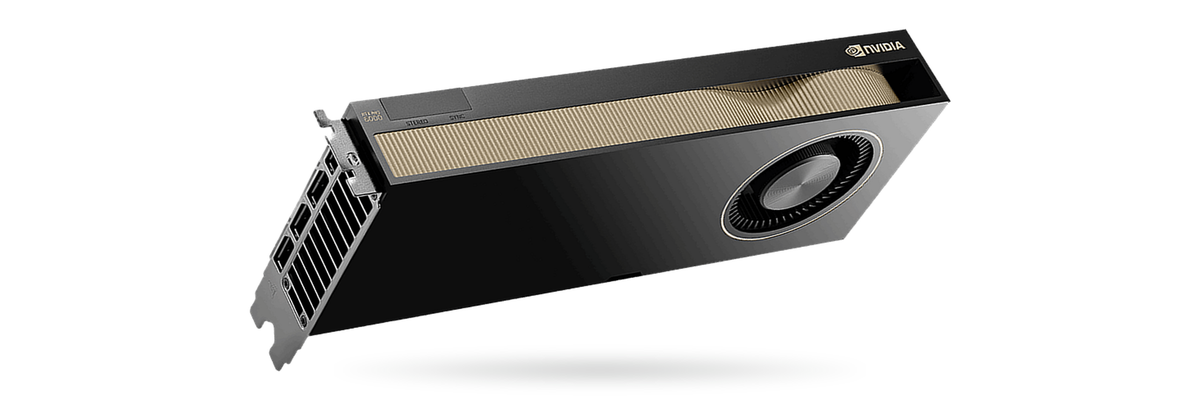
A self-hosted Otter alternative that keeps recordings out of the cloud is an open web app on an office workstation. It accepts an audio file, produces a transcript with speakers marked, writes a summary with a local language model and hands the text over for export. As of October 2026 two ready-made projects do this, Scriberr and Whishper, and either of them serves a team on a single NVIDIA RTX PRO 4500 Blackwell with 32 GB. The main things you lose are the bot that dials into video calls on its own and the mobile apps.
Memory sizing for larger servers is covered in our article on a speech recognition server for Whisper. This one is about the app a team uses every day, about Ukrainian and Russian, and about what Ukraine's Law No. 2297-VI expects when conversations are recorded.
In brief
- A local app reproduces the Otter cycle (upload, transcript with speakers, summary, export) on a company machine, so recordings never leave it.
- Scriberr (MIT) runs Parakeet, Canary and Whisper, labels speakers and summarises through Ollama; Whishper (AGPL-3.0) is built on faster-whisper and has a subtitle editor.
- On Ukrainian FLEURS, the NVIDIA paper gives Whisper large-v3 a WER of 6.51%, Parakeet TDT 0.6B v3 6.79% and Canary-1B v2 10.50%.
- Scriberr development is on hold with a promised restart (latest version v1.2.0), and Whishper has frozen its main branch during the rewrite of version 4.
- By our estimate, an RTX PRO 4500 with 32 GB fits Whisper large plus gpt-oss-20b for summaries simultaneously.
Otter or a self-hosted app: what changes for the team
Otter's website, as read on 30 October 2026, presents a meeting agent: live transcription, chat, automatic summaries and follow-up tasks. Through Google Calendar the agent joins Zoom, Teams and Google Meet sessions by itself, and there are iOS and Android apps. Happy Scribe, on the same day, offered transcription in more than 150 languages, subtitles, export to DOCX, PDF, SRT and VTT, and storage of recordings in the EU. Article 29 of Law No. 2297-VI allows data transfers to EEA countries, yet the processor is still an outside one. A local app removes it.
| Feature | Otter, per its website | Scriberr | Whishper |
|---|---|---|---|
| Uploading recordings | audio and video import | yes, plus a folder watcher | yes |
| Recording in the app | desktop, mobile, browser | built-in recorder | not mentioned in the README |
| Joining video calls | agent via calendar | not mentioned in the README | not mentioned in the README |
| Speaker labels | yes | yes, via PyAnnote | not mentioned in the README |
| Summaries and questions | yes | via Ollama or an OpenAI-compatible server | no |
| Subtitles and translation | not mentioned on the home page | not mentioned in the README | editor, SRT and VTT, LibreTranslate |
| Runs on | the vendor's service | your machine | your machine |
Source: Otter home page; Scriberr and Whishper READMEs on GitHub; read 30.10.2026.
Audio, transcript and summary stay on the workstation as long as the summary model runs there as well. Scriberr can call any provider with an OpenAI-compatible API, and since v1.2.0 it can also transcribe through OpenAI, so whoever configures it decides where the data goes. In a local set-up, Ollama or vLLM on the same machine produces the summaries. A Zoom or Teams meeting still travels through that service, which is why the usual input is a recording from a participant's computer or a dictaphone file.
Scriberr, Whishper, WhisperX and Speaches compared
Of the four projects, two are finished web apps for end users and two are building blocks for an IT department.
| Project | Kind | Licence | Recognition engine | Status in October 2026 |
|---|---|---|---|---|
| Scriberr | web application | MIT | Parakeet, Canary, Whisper | v1.2.0; development on hold, restart announced |
| Whishper | web application | AGPL-3.0 | faster-whisper | main branch frozen; version 4 being rewritten |
| WhisperX | Python library with CLI | BSD-2-Clause | Whisper via faster-whisper | version 3.8.6, 25.05.2026 |
| Speaches | speech API server | MIT | faster-whisper | v0.9.0-rc.3, release candidate |
Source: GitHub pages of Scriberr, Whishper and Speaches, PyPI page of WhisperX, read 30.10.2026. GitHub stars: Scriberr 3.1k, Whishper 3.1k, Speaches 3.7k.
Scriberr describes itself as a fully offline application. It timestamps every word, identifies speakers automatically and answers questions about a transcript through a connected language model. Its text viewer follows the audio during playback, passages can be highlighted and annotated, a folder watcher picks up new files, and v1.2.0 brought webhooks and a command-line utility. The README lists neither export formats nor user roles, so expect one shared workspace per team inside the corporate network.
Whishper transcribes and translates locally through a web interface. Its subtitle editor splits segments, warns when there are too many characters per second and highlights text in step with playback; export covers TXT, JSON, VTT and SRT. Logging in with user accounts is still only planned, so the app should sit on a trusted company network, or behind a reverse proxy that does the sign-in.
WhisperX is aimed at IT teams. Its PyPI page promises batch processing at 70 times real time on whisper large-v2 and under 8 GB of GPU memory. Word timestamps come from wav2vec2 alignment, whose default models cover English, French, German, Spanish and Italian; the four non-English ones carry the non-commercial CC BY-NC 4.0 licence. Ukrainian and Russian are not on that list, so an alignment model for them is set separately and its licence checked.
Speaches is a server with an OpenAI-compatible API for transcription, translation and speech synthesis. It fits when a company wants one central speech service that other programs call, dictation tools for example. Version v0.9.0-rc.3 is only a release candidate, so pin the exact version you deploy.
Ukrainian and Russian accuracy in Scriberr and Whishper
The apps do not recognise speech themselves; everything depends on the model underneath. Whisper large-v3, Parakeet TDT 0.6B v3 and Canary-1B v2 all support both languages, and an NVIDIA paper compares them with a single method.
| Model | Licence | WER uk, FLEURS (%) | WER ru, FLEURS (%) |
|---|---|---|---|
| Whisper large-v3 | MIT | 6.51 | 4.17 |
| Parakeet TDT 0.6B v3 | CC-BY-4.0 | 6.79 | 5.51 |
| Canary-1B v2 | CC-BY-4.0 | 10.50 | 6.90 |
Source: NVIDIA paper arXiv 2509.14128; licences from the OpenAI repository and the model cards; read 13.11.2026.
WER is the share of words recognised wrongly. FLEURS consists of read-aloud sentences, so meetings and phone calls will produce noticeably more errors. The same model also scores differently from one measurement to the next: on the Handy leaderboard (FLEURS, Q8_0 weights) Parakeet v3 reaches 6.84% in Ukrainian, while the lowest Russian WER there belongs to Whisper large-v3 at 4.96%. We found no published measurements on Surzhyk or on meetings that mix Ukrainian and Russian. More on models for both languages is in our article on recognising Ukrainian and Russian locally.
The pyannote speaker-diarization-community-1 card gives no DER for Ukrainian or Russian, so test speaker labelling on your own recordings. For translation through LibreTranslate we found no published data for Ukrainian.
Project maintenance and licences for company use
Both web apps are run by small teams. Scriberr's README has an undated section saying development is "paused for now", though not abandoned, and a line at the top promises a return to work within the week; the latest version is still v1.2.0, so look at the commit history before installing. According to its README, Whishper's main branch will get no further versions. The programs keep working regardless, but it pays to pin the installed version, keep the container image and the models on your own storage, and name in advance the person who applies security fixes.
Scriberr is MIT-licensed. Whishper uses AGPL-3.0, whose section 13 requires a modified version to offer its code to users who interact with it over a network; if you change the code, have a lawyer review that section beforehand. Whisper's code and weights are published by OpenAI under MIT. Scriberr relies on a WhisperX environment, so check which alignment model it loads for Ukrainian and Russian and install one that permits commercial use. Parakeet and Canary are under CC BY 4.0 and, according to their cards, ready for commercial use. Pyannote community-1 is also CC BY 4.0 but gated: once the terms are accepted and a Hugging Face token is supplied, the local copy runs without internet access.
How to run Scriberr on RTX PRO Blackwell
Scriberr offers three Docker image variants: CPU, CUDA for GPUs from Pascal to Ada, and scriberr-cuda-blackwell. For RTX 50 cards the README insists on the Blackwell image, since the standard one fails on PyTorch and CUDA compatibility. RTX PRO cards are not named, but the image is tied to sm_120, which is the compute capability of RTX PRO Blackwell; a first test after installation confirms it.
GPU access needs the NVIDIA Container Toolkit, the first start spends several minutes downloading the PyAnnote models, and a machine meant to run offline needs every model saved locally beforehand. This is where a first installation tends to stall. ETE can supply the workstation alone, while Vixen.UNO engineers install Scriberr or Whishper with recognition and summary models separately or together with it.
Which GPU you need for transcription
Recognition puts little load on a GPU. A paper on the Open ASR Leaderboard (arXiv 2510.06961v3, December 2025) reports that on one A100 with a batch of 64, Whisper large-v3 processed 145.5 seconds of audio per second and Parakeet TDT 0.6B v3 around 3,333. By our calculation, an hour-long recording takes roughly 25 seconds with Whisper there and about a second with Parakeet. We found no such figures for RTX PRO cards, and the pyannote card does not state a speed for speaker labelling. So two questions decide the card: whether the summary model runs alongside, and how many uploads are processed at once.
| Level | GPU and memory | Workload | Users |
|---|---|---|---|
| Starter workstation | RTX PRO 4000 Blackwell (24 GB), one card | recognition with speaker labels; summaries off or in turn | one team, uploads queued |
| Main workstation | RTX PRO 4500 Blackwell (32 GB), one card | gpt-oss-20b and Whisper large loaded together | a team or department with summaries |
| Workstation with headroom | RTX PRO 5000 Blackwell (48 GB or 72 GB), one card | several jobs in parallel | several departments uploading simultaneously |
| Company-wide server | two RTX PRO 6000 Server Edition cards | MIG instances for recognition; gpt-oss-120b summarises | one service for the whole company |
Source: usable memory by our rule (90% of the memory the driver reports, minus 3 GiB): 18.5, 25.7, 40.0 or 61.5 GiB; Whisper large about 10 GB (OpenAI repository), gpt-oss-20b weights 13.76 GB (Hugging Face); our estimate.
Whisper large takes about 10 GB, or 9.3 GiB, and the gpt-oss-20b weights (Apache 2.0) 13.76 GB, or 12.8 GiB. Together that makes 22.1 GiB: above the 18.5 GiB available on a 24 GB card and below the 25.7 GiB on the RTX PRO 4500, which leaves roughly 3.6 GiB of working memory for the summary model. The speaker-labelling model comes on top, and the pyannote card does not state how much memory it needs. On a 24 GB card, summaries run once the recognition model is unloaded, or on another machine. The 48 GB RTX PRO 5000 keeps around 18 GiB free after both models for parallel jobs. ETE works out the configuration for your users and hours of audio from the actual load.
The RTX PRO 4500 draws 200 W, so a single-card workstation stays well under the 2.94 kW limit of a 16 A circuit at 230 V loaded to 80%. A server with two RTX PRO 6000 Server Edition cards of 96 GB each draws, by our estimate, roughly 1.8 kW from the mains; given power cuts in Ukraine, it is planned together with a UPS and a generator (see our article on powering a workstation with several GPUs). The layout with MIG on one card and gpt-oss-120b on the other is described in our article on meeting minutes with local AI.
Recording and transcribing conversations under Ukrainian law
Your own server removes the outside provider, though not the company's obligations around recordings. Ukraine has no dedicated law on call recording by commercial companies, so general rules apply: the Constitution guarantees the privacy of telephone conversations (Art. 31) and prohibits collecting confidential information about a person without consent, except where the law provides otherwise (Art. 32). A voice and a recorded conversation are personal data, so one of the six grounds in Article 11 of Law No. 2297-VI is needed (consent, contract, legitimate interest and so on), and under Article 12 the person is told in advance who records, for what purpose and what rights they have.
In practice, the recording and its purpose are announced at the start of the conversation, and audio and transcripts are kept only as long as that purpose requires. Bill No. 8153, which brings the law closer to the GDPR, had not been adopted as of November 2026. This overview is not legal advice; your lawyer confirms the details.
What to check before switching
Take 20 to 30 minutes of typical audio (a client call, a meeting, a voice note) and feed it to both apps.
- Languages. Compare accuracy in Ukrainian, Russian and mixed recordings; count names and numbers separately.
- How audio arrives. Agree who makes recordings and where they get uploaded, or point Scriberr's folder watcher at a shared folder.
- Export. If transcripts have to end up in Word, add a conversion step.
- Access. Place the app behind corporate sign-in or a VPN.
- Outbound calls. Make sure summaries go to the local model and no component sends audio to the cloud.
For one-off research or press interviews there is a simpler route: noScribe on your own computer.
FAQ
Is there an open alternative to Otter that I can install myself?
Yes, Scriberr and Whishper transcribe uploaded recordings on your own machine. Neither has a bot for calls, and as of October 2026 the maintenance of both is uncertain.
Scriberr or Whishper: which should a team choose?
Scriberr, under MIT, suits teams that need speakers, summaries and questions about a transcript. Whishper, under AGPL-3.0, is handier for subtitles and translation, but it has no user sign-in yet.
Does Scriberr recognise Ukrainian?
Yes, all three of its engines support Ukrainian and Russian. On Ukrainian FLEURS, Whisper large-v3 has a WER of 6.51%, Parakeet v3 6.79% and Canary 10.50%. There is no data for Surzhyk, so test the models on your own recordings.
What GPU does a transcription server need?
For a single team, by our estimate, an RTX PRO 4500 with 32 GB is enough to hold Whisper large and gpt-oss-20b at once. A 24 GB card recognises speech and labels speakers but cannot fit both models together. Several departments are better served by an RTX PRO 5000 with 48 GB.
Is it legal to transcribe meetings locally in Ukraine?
It is, provided the same conditions are met as for any processing of recordings: a ground under Article 11 of Law No. 2297-VI, informing participants beforehand under Article 12, and a defined retention period. A lawyer confirms the details for your case.
What ETE supplies for this
- NVIDIA RTX PRO 4500 Blackwell 32 GB: holds Whisper large and gpt-oss-20b at once on 200 W.
- NVIDIA RTX PRO 5000 Blackwell 48 GB: spare memory for parallel jobs from several departments.
- NVIDIA RTX PRO 4000 SFF Blackwell 24 GB: the same 24 GB as the entry level, for recognition with summaries in turn.
- NVIDIA RTX PRO 6000 Server Edition 96 GB: two cards in a server for MIG-based recognition and gpt-oss-120b.
Need a transcription workstation for your team?
Tell us which languages you work in, how many hours of audio you process a week and how many people will use the app. ETE works out the configuration and, where needed, Vixen.UNO engineers install Scriberr or Whishper with the models.