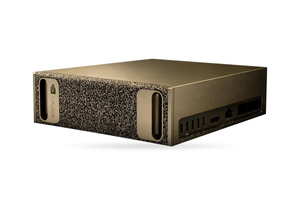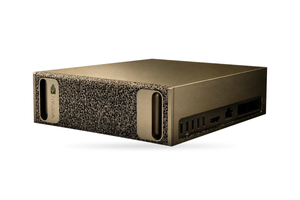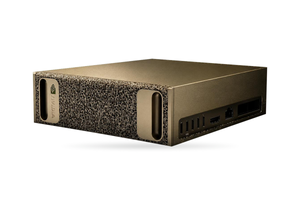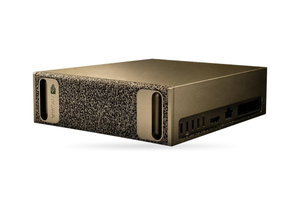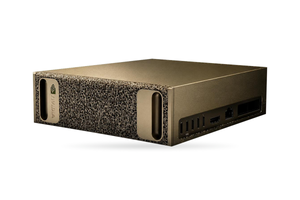

Live captions for a meeting, lecture or conference can be produced entirely on hardware you own: sound from the mixing console travels to a server inside the building, a streaming model on a GPU turns it into text within a fraction of a second, and a web page in the browser puts that text on a screen or projector. As of October 2026 the open options are WhisperLiveKit and Collabora's WhisperLive, and a workstation with a single NVIDIA RTX PRO 4000 Blackwell is enough for the first hall. Neither the audio nor the text leaves the premises.
This piece is for event organisers, universities, HR teams and public bodies that hold open sessions. Delay here means the gap between a spoken word and its appearance on screen, and WER counts wrong, missed and inserted words per 100 words of a correct transcript. Handling recordings after an event is covered in our article on meeting minutes with a local AI.
In brief
- Local subtitles lag the speaker by 80 ms to 2.4 s; the exact figure is set by the model and how it is configured.
- Voxtral Mini 4B Realtime and Qwen3-ASR do not handle Ukrainian; inside WhisperLiveKit that leaves Whisper via faster-whisper and Canary, while Nemotron 3.5 ASR Streaming knows both Ukrainian and Russian but has to be integrated.
- The open tools: WhisperLiveKit 0.2.26 (Apache 2.0, its own page, live speaker labels) and WhisperLive 0.10.0 from Collabora (MIT; runs on faster-whisper, OpenVINO or TensorRT).
- Room sound matters as much as the model: the Parakeet TDT 0.6B v3 card shows a WER of 11.31% on meeting recordings versus 1.93% on clean read speech.
- A 24 GB RTX PRO 4000 Blackwell holds Whisper large-v3 (about 10 GB) for one hall; a campus needs a server with L40S or RTX PRO 6000 Server Edition cards.
How live subtitles work in a hall
| Step | What happens | Equipment |
|---|---|---|
| 1. Pick-up | speaker microphones feed the mixing console | the sound system already in place, a spare console output |
| 2. Transport | a small computer sends the sound on to the subtitle server | an audio interface plus a browser page or client |
| 3. Recognition | the streaming model emits text in short increments | the GPU inside the workstation or server |
| 4. Display | text shows up on a projector, a screen or an extra display | a full-screen browser page |
| 5. Keep or discard | the transcript is stored or destroyed once the event ends | a retention rule agreed in advance |
Source: our summary; client and server roles per the WhisperLiveKit and WhisperLive documentation, read on 30.10.2026.
Subtitle quality starts with the sound. According to NVIDIA's card, Parakeet TDT 0.6B v3 scores a WER of 11.31% on the AMI meeting recordings and 1.93% on LibriSpeech test-clean, which is read aloud close to the microphone. The noise test tells the same story: the average error share climbs from 6.34% on clean audio to 11.66% once noise is as loud as the voice. In a hall, take the feed from the console, where headsets and lectern microphones are already mixed, and leave question microphones and music out of it. A meeting room without a console needs at least a conference microphone placed at the centre of the table.
The WhisperLiveKit page records, via the browser, the microphone input of whatever computer opens it, and shows the subtitles on that same page. A laptop next to the console can therefore send the sound and drive the projector at once, while recognition happens on a server in another room.
Delay, accuracy and the Ukrainian language
A streaming model has to settle on words before a sentence is finished, so it sees less context, and the longer it is allowed to wait, the fewer errors it makes. For Ukrainian we found no published data on this. For Russian the Voxtral Mini 4B Realtime card provides it: 6.02% on FLEURS at 480 ms and 5.41% at 2,400 ms. Mistral calls 480 ms the optimal balance; by our count that still means an error in roughly every seventeenth word on clean speech. In a lecture, one or two seconds of delay give better accuracy, whereas in a discussion half a second keeps the text closer to the speaker.
The Handy ranking lets you compare models for both languages under the same conditions. It scores finished recordings without streaming delay, so live use will produce more errors.
| Model | WER uk, % | WER ru, % | WhisperLiveKit back end |
|---|---|---|---|
| Whisper large-v3 | 6.28 | 4.96 | yes, via faster-whisper |
| Canary-1B v2 | 10.58 | 7.83 | yes, Canary-1B v2 via NeMo (the default model) |
| Nemotron 3.5 ASR Streaming 0.6B | 14.88 | 12.61 | no, integration required |
| Voxtral Mini 4B Realtime | no Ukrainian | 5.41 | yes |
| Qwen3-ASR-1.7B | no Ukrainian | 6.25 | yes |
Source: Handy ranking (models.handy.computer), FLEURS test split, Q8_0 weights, read on 13.11.2026; language support per model cards; back ends per the WhisperLiveKit README on GitHub, read on 13.11.2026.
Whisper is not a streaming model: it handles 30-second windows, and the large-v3 card names that length as optimal. Live tools put it inside a streaming policy that keeps re-reading the lengthening audio and judges which words have settled: WhisperLiveKit defaults to SimulStreaming, and WhisperLive describes itself as working almost live. The WhisperLiveKit README warns that Whisper's automatic language detection leans towards English, so for a Ukrainian event set the language explicitly, and test speakers switching between Ukrainian and Russian at the rehearsal. Models for Ukrainian are compared in our article on local Ukrainian speech recognition.
Open tools as of October 2026
| Tool or model | Release | Role | Licence |
|---|---|---|---|
| WhisperLiveKit | 0.2.26 (29.08.2026) | subtitle server with its own page; back ends faster-whisper, Voxtral, Qwen3-ASR and Canary; live speakers; translation | Apache 2.0 |
| WhisperLive by Collabora | 0.10.0 (07.09.2026) | subtitle server on faster-whisper, OpenVINO or TensorRT; add-ons for Chrome and Firefox | MIT |
| Voxtral Mini 4B Realtime | a model | 13 languages including Russian, no Ukrainian; vLLM serves it on a realtime endpoint | Apache 2.0 |
| Nemotron 3.5 ASR Streaming | a model (04.06.2026) | 40 locales of which 32 are ready for use; punctuation included | OpenMDW-1.1 |
Source: WhisperLiveKit and WhisperLive pages on PyPI, the WhisperLiveKit GitHub page, model cards on Hugging Face; read on 30.10.2026.
WhisperLiveKit presents itself as a self-hosted recognition pipeline with very low delay. It serves its own page on port 8000 and offers a Chrome add-on for web-page audio, an OpenAI-compatible REST endpoint and WebSocket. Its README says the back end handles several users at once, and access can be locked with an API token.
Collabora's WhisperLive drives Whisper via faster-whisper, OpenVINO or TensorRT, and its Chrome and Firefox add-ons transcribe sound straight from the browser. Two defaults matter at events: --max_clients defaults to 4 and --max_connection_time to 600 seconds, so unless you change the setting a session stops after ten minutes.
Voxtral Mini 4B Realtime 2602 from Mistral accepts a delay in 80 ms steps from 80 to 1,200 ms, or 2,400 ms, and vLLM serves it on /v1/realtime over WebSocket; of Ukrainian and Russian it only knows Russian. NVIDIA's Nemotron 3.5 ASR Streaming 0.6B recognises both languages, adds punctuation and capitals itself and works in chunks from 80 ms to 1.12 s in NeMo or Transformers 5.13.0 and later. Neither subtitle tool lists it as a back end, so hooking it up is a separate integration job.
Who is speaking, and translated subtitles
Speakers. WhisperLiveKit labels one to four speakers live using NVIDIA's Streaming Sortformer; according to the README it assigns each moment to a single speaker, so overlapping voices are not shown, and surplus speakers may inherit someone else's label. Nemotron 3 Diarization (NVIDIA, 23.09.2026, OpenMDW License 1.1) separates up to eight speakers and has a 0.32-second delay profile; on AMI meetings captured with one distant microphone its DER in that profile is 12.95% versus 11.14% offline. If every participant has a microphone, separate streams identify the speaker with no model at all. More in our article on speaker diarisation on your own server.
Translation. WhisperLive can turn any language into English, and a translation thread on the server can aim at other languages too. In WhisperLiveKit, --target-language relies on NLLW, built on distilled NLLB for 200 languages, and the NLLB-200 distilled 600M card is tagged CC BY-NC 4.0 and calls the model a research model not meant for production use. A business needs a commercially licensed model, for example through the alignatt back end, where an LLM does the translating in place of NLLB. For Ukrainian under Apache 2.0 there are OPUS-MT uk-en (Ukrainian into English) and Dragoman (English into Ukrainian only), but we have not checked how they plug into WhisperLiveKit; a comparison is in our article on machine translation on your own server. Two languages mean two pages and two screens.
Colleagues with hearing loss, hybrid meetings and personal data
Agree in advance with colleagues who are deaf or hard of hearing on the delay, where the text sits on screen and whether automatic subtitles, which will contain errors, are adequate. For viewers to follow on their phones you need a page that pushes one hall's subtitles to many devices; neither README describes one, so it is built during implementation.
For hybrid meetings both projects capture sound from a browser tab, but then only the subtitle processing stays local: the meeting audio still passes through the video-call service.
What identifiable people say is personal data even when nothing is stored, so under Ukraine's Law No. 2297-VI you need one of the six grounds in Article 11 (consent, contract, legitimate interest and so on), and speakers and participants are informed beforehand under Article 12 about who processes the data, why, and what rights they have. Keep a saved transcript only as long as its purpose requires. Bill No. 8153, which moves closer to the GDPR, had not been adopted as of November 2026; this is not legal advice, and your lawyer should confirm the details.
Hardware from a meeting room to a conference centre
Viewers put no load on the GPU; the hardware is set by the number of halls running at once, the model, the delay, speaker labels and translation. We found no data on stream counts for Ukrainian or for RTX PRO cards. The closest figure is for English: NVIDIA's ASR NIM performance page (07.10.2026) gives a single L40S up to 190 live streams of Parakeet 0.6B CTC with 160 ms chunks, and 64 streams at an average delay of 33.9 ms on a LibriSpeech file. Voxtral, at 4 billion parameters, needs far more compute per stream.
| Level | Hardware | Workload | Halls in parallel |
|---|---|---|---|
| Entry workstation | one RTX PRO 4000 Blackwell, 24 GB (145 W; SFF version 70 W) | Whisper large-v3 in WhisperLiveKit; Voxtral Mini 4B Realtime for Russian-language events | one hall; more with a 0.6B model once tested |
| Mid workstation | one RTX PRO 5000 Blackwell, 48 GB, 300 W | a streaming model, live speakers and a commercially licensed translation model | several halls, or subtitles in two languages |
| Campus server | L4 cards at 24 GB and 72 W each, or 48 GB L40S | a single streaming model per card | lecture theatres and meeting rooms side by side |
| Shared company server | two RTX PRO 6000 Server Edition | subtitles in their own MIG slice beside the corporate assistant | when subtitles are just one of several services |
Source: card memory and power per NVIDIA; usable memory by our rule, 18.5 GiB on 24 GB and 40.0 GiB on 48 GB; model memory per the cards quoted; hall counts are our estimate, to be confirmed by testing.
Entry workstation. By our rule (90% of the memory the driver reports, minus 3 GiB) the RTX PRO 4000 Blackwell offers 18.5 GiB. That covers Whisper large-v3 or Voxtral Mini 4B Realtime, which according to its card needs a GPU with 16 GB or more. WhisperLiveKit recommends, for one of its streaming back ends, a single real-time session per GPU. A 0.6-billion-parameter model is lighter: version 26.05.0 of the support matrix for NVIDIA's speech NIM gives 6 GB at batch size 32 for the Nemotron ASR Streaming profile.
Mid workstation. The RTX PRO 5000 Blackwell with 48 GB offers 40.0 GiB: by our estimate that is enough for a streaming model, speakers and translation, but the diarisation card does not state memory, so a test confirms the split. On this card Nemotron 3 Diarization in the 0.32-second profile runs 12.5 times faster than real time (batch 1, uncompiled) and 292 times (batch 32, compiled model), so for a few halls speaker labelling adds little load.
Server. For a campus, a rack server with several L4 cards (24 GB, 72 W, low profile) or 48 GB L40S cards gives each hall its own card. A server with two 96 GB RTX PRO 6000 Server Edition cards runs subtitles in a MIG instance beside the company chat assistant; it draws about 1.8 kW (our estimate), so given the power cuts it is planned with a UPS and a generator. ETE works out the configuration for your number of halls and languages from the real workload, and Vixen.UNO engineers can set up WhisperLiveKit or WhisperLive with a Ukrainian-capable model when needed.
What IT configures on the subtitle server
- Network. Sound and subtitles travel over WebSocket. WhisperLiveKit's deployment notes cover
--api-token,--cors-originsand--forwarded-allow-ips, TLS viawss://using--ssl-keyfileand--ssl-certfile, and Nginx in front with the WebSocket upgrade headers, passing to Uvicorn workers under Gunicorn; in WhisperLive, raise the session limits. - Installation. For CUDA 12.9 WhisperLiveKit offers the
cu129extra, and there is a Dockerfile for GPUs (docker run --gpus all -p 8000:8000); the Qwen3 back end on vLLM needs its own environment, and some extras clash. - Voxtral Realtime. Install a recent vLLM plus mistral_common from version 1.9.0, and use WebSocket for audio sessions as Mistral advises. If speakers or translation share the card, lower
--gpu-memory-utilizationin vLLM from the standard 0.92, since vLLM reserves that share of memory at start-up. - Licences. AmberNet, used to identify the language, is distributed through NVIDIA NGC on separate terms, SenseVoiceSmall has its own licence, and the default Sortformer speaker model is under CC BY 4.0, which requires attribution.
- Rehearsal. In the actual hall with the actual microphones, measure the delay, read out a list of names and product terms, and choose the font size from the back row.
FAQ
Can live subtitles run without a cloud service?
Yes. A streaming model runs on a GPU in your building, WhisperLiveKit or WhisperLive takes the sound from the hall, and a browser page shows the subtitles on screen. Sound and text remain on your own hardware.
Which model gives live subtitles in Ukrainian?
Voxtral Mini 4B Realtime and Qwen3-ASR do not support Ukrainian. In WhisperLiveKit that leaves Whisper via faster-whisper and Canary-1B v2: in the Handy ranking on Ukrainian FLEURS, Whisper large-v3 scores 6.28% and Canary-1B v2 10.58%. Nemotron 3.5 ASR Streaming does recognise Ukrainian (14.88% in Handy) but has to be integrated.
How much delay do live subtitles have?
That is a setting. Voxtral Mini 4B Realtime accepts 80 ms to 1.2 seconds in 80 ms steps, or 2.4 seconds, with 480 ms by default; Nemotron 3.5 ASR Streaming works on 80 ms to 1.12 s chunks. A longer delay means fewer errors.
Which graphics card do subtitles at an event need?
One hall is covered by an RTX PRO 4000 Blackwell with 24 GB running Whisper large-v3. With 48 GB, an RTX PRO 5000 also fits live speakers and translation. A campus server carries L4 or L40S cards, one for every hall.
Can live subtitles be translated into another language?
Yes, if a translation model sits behind the recogniser. WhisperLive translates into English, while the NLLB-based model in WhisperLiveKit carries a non-commercial licence, so a company event needs a commercially licensed one.
What ETE supplies for this
- NVIDIA RTX PRO 4000 SFF Blackwell 24 GB: 24 GB for one hall's subtitles with Whisper large-v3.
- NVIDIA RTX PRO 5000 Blackwell 48 GB: a streaming model, live speakers and translation on one card.
- NVIDIA L40S 48 GB: a dedicated card for each hall in a campus server.
- ETE AI Server RTX PRO: four 96 GB RTX PRO 6000 cards, subtitles in a MIG instance next to the company's other AI services.
Need live subtitles in your halls?
Tell us how many halls you subtitle at once, which languages your speakers use and how your sound is mixed today. ETE will work out the configuration and, when needed, Vixen.UNO engineers will install WhisperLiveKit or WhisperLive with a model for your language.